Find one useful next step when your mind won’t settle.
Practical CBT self-help written for Muslims, with the Qur’an and Sunnah in view. Start with a short guide for one struggle, or work through eight structured weeks.
Or tell us what’s weighing on you most
Your answer stays on this page. It is not saved or sent anywhere.
For the loop of checking, rehearsing and imagining the worst. Six short chapters on telling a fact from a prediction, sorting what belongs to your effort, and bringing the worry to Allah while you act.
For the inner voice that calls you careless, useless or never enough. Practise describing what happened without the verdict, correcting yourself without cruelty, and taking feedback without accepting humiliation.
For guilt that keeps replaying long after you have asked forgiveness. Name what happened honestly, turn back to Allah, repair what is yours to repair, and keep living while your feelings catch up.
Eight weeks of steady practice: a mood diary, thought records, a fear ladder, worry tools, a sleep log and a maintenance plan, with faith-consistent reflection each week.
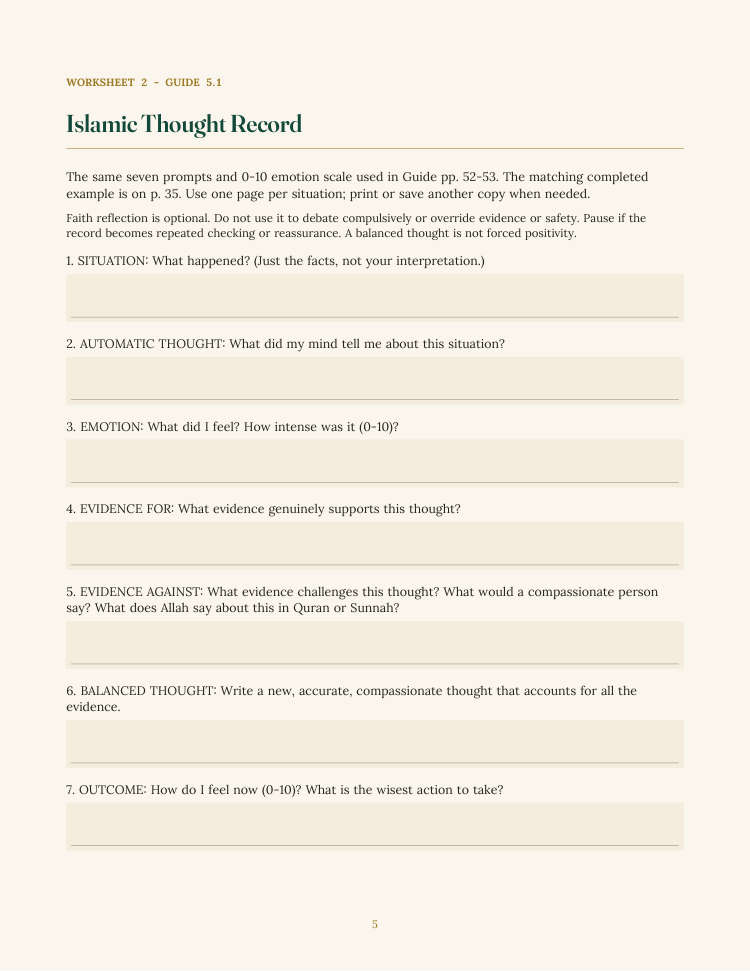
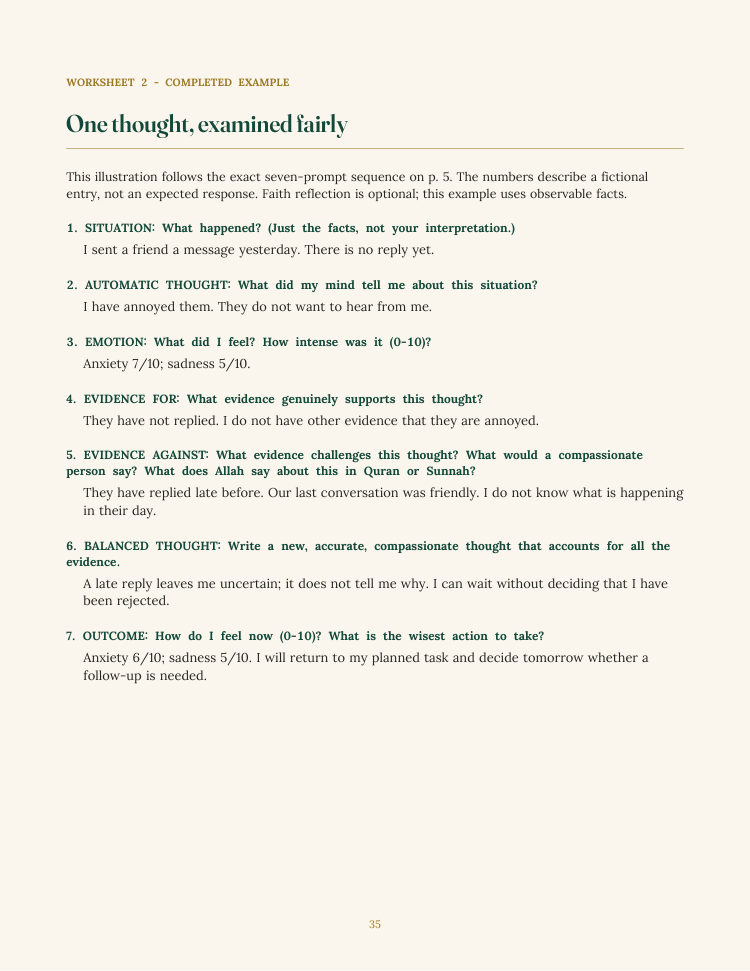
Five pages: the opening of Chapter 1, a completed thought record and a blank one to try on something from your own week. Print it or fill it in on screen.
If you might harm yourself or someone else, or you cannot keep yourself safe, contact your local emergency number or a crisis line now. If you can, stay with someone you trust while you do.
Reaching out is not a failure of faith or of effort.
Yusuf has already sent the requested documents. At breakfast, he checks his inbox. At work, he rereads his application. By evening, he is imagining how he will explain a rejection to his family. Nothing new has arrived.
You practise asking what a round of thinking is actually producing, sorting what belongs to your effort from what you cannot decide, and choosing one step small enough to take today.
Samira uses an old figure in a work presentation. She corrects it, finishes speaking and gets a useful question. On the journey home she remembers only the error: “You always embarrass yourself. Everyone can see you are not good enough.”
You practise separating the event from the verdict, so you can fix what went wrong without attacking the person who has to fix it.
Bilal tells a friend something private about another person. Later he regrets it. His first impulse is to send a long message about how terrible he feels and ask everyone involved to tell him he is still a good person.
You practise turning remorse into repair: what needs to stop, what is yours to make right, and when a question belongs with a qualified scholar.
Healing the Heart & Mind: eight weeks of steady practice
A self-paced programme for Muslim adults working through worry, low mood, avoidance and harsh self-talk. Each week you read a little, then practise.
137-page main guide
50-page workbook, in print and fillable formats
18-page devotional companion, Turning to Allah in Difficult Times
Week 1: Foundation, knowing yourself
Keep a daily mood and behaviour diary and notice your main emotional and spiritual triggers. Optional PHQ-9 and GAD-7 self-checks give you a personal starting point, not a diagnosis.
Week 2: Activation, moving the body and soul
Turn “be more sociable” into a plan: one meaningful action with a time and a place, then a short note on how it went.
Week 3: Inner voice, catching distortions
Use thought records to notice thinking traps and test them against the evidence.
Week 4: Courage, the first step on the ladder
Build a fear ladder for something you avoid, and take only the first manageable step.
Week 5: Worry, sorting what is mine
Separate worries you can act on from those you cannot control, and give each the response it needs.
Week 6: Body, the vessel of healing
Keep a sleep log and look at how rest and the body shape the way you feel.
Week 7: Sakinah, dwelling in the present
Optional paced breathing, a tafakkur session and one salah prayed with your phone in another room.
Week 8: Review, integration and commitment
Open your Week 1 pages, notice what has changed and what has not, and write a maintenance plan.
You deserve to know exactly what you are buying, who made it, and when something else would serve you better.
How faith and psychology meet here
MuslimCBT teaches familiar CBT self-help tools, such as thought records, activity planning and worry tools, in a faith-consistent context. Qur’an and hadith passages are summarised in plain English, labelled as summaries and linked so you can read them in full.
Written by Ibnu Nahid, founder and researcher at MuslimCBT, who is not a licensed psychologist, psychiatrist, psychotherapist or doctor. About MuslimCBT
Dr Mishal Salem, PhD, an Islamic psychologist and philosophical counsellor, is credited for externally reviewing the main guide’s Islamic content and faith-sensitive framing. That review does not establish clinical validation. The companion and the Everyday Life Series have not had a separate external review.
Choose professional support first if
You are thinking about suicide or self-harm, or cannot keep yourself safe.
Symptoms are severe, getting worse, or stopping you from managing daily life.
You may have OCD, trauma-related symptoms or another condition that needs assessment.
If one everyday struggle stands out, such as overthinking, a harsh inner voice or guilt after a mistake, start with the short guide for it. If worry, low mood or avoidance has been with you for weeks, the eight-week programme gives you more structure. Not sure? Start with the free starter kit.
What do I receive when I buy?
Each Everyday Life Series book is one PDF, and the bundle gives you all three. Healing the Heart & Mind is four PDFs: the 137-page main guide, the 50-page workbook in print and fillable formats, and the 18-page companion, Turning to Allah in Difficult Times.
Is this therapy?
No. MuslimCBT is educational self-help. It does not diagnose or treat any condition. Severe distress, significant difficulty functioning or possible OCD needs appropriate professional support.
How are the Qur’an and hadith used?
Passages are summarised in plain English and labelled as summaries, separate from the author’s reflections, with links to read each one in full. We do not present worship as a clinical technique. Read the methodology.
How do payment and refunds work?
The books are sold through Gumroad. The programme is paid through Gumroad or Razorpay, depending on the checkout available to you, and has a 30-day refund policy. See the cancellation and refund policy.
Can I write in the pages on my phone?
The programme includes a fillable workbook you can complete in a PDF reader that supports forms. Download it, save a copy and reopen it to check your entries are kept. The books’ writing pages are designed for printing, or you can use a notebook.
Not ready to buy? Start with one page of practice.
Download the free starter kit, see a completed example, then try the blank thought record on something from your own week.
Choosing professional care is not a failure of self-help. Start with our guide to finding Muslim-sensitive support, and check each provider’s credentials yourself.